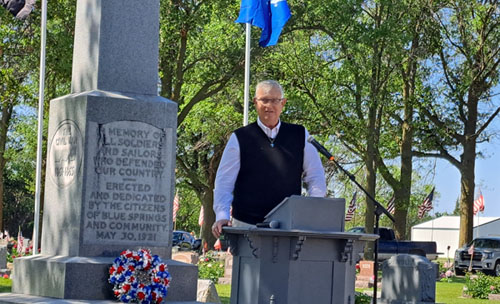
 Guest Spreaker - Dr. Kent Mann Welcome to the Memorial Day Services here at the Blue Springs Cemetery. In a cemetery much like this one, on November 19, 1863 President Abraham Lincoln delivered the famous Gettysburg Address at the National Cemetery in Gettysburg. Prior to his arrival, the people of Gettysburg had placed flowers on the graves of the fallen. Many believe this was the origin of Decoration Day. Decoration Day became a national day of observance. Each year, people across the country would lay flowers on the graves of those fallen in battle as well as those who have gone on before us. By an act of Congress in 1971, Decoration Day became a national holiday but the name of the holiday was changed to Memorial Day. Today, people across the nation gather on the last Monday of May to pay tribute to those who have gone before us by decorating graves and sharing in memorial services. I'm privileged to be a part of the Memorial Day services here today with you as we gather to remember the sacrifices made by those patriots who gave their last full measure of devotion in service to this great nation. Thank you for continuing this hallowed tradition in Nebraska’s oldest registered cemetery. The cemetery was founded in 1860 and was officially registered in 1862. Have you noticed how some words in the English language seem to be over-used or misused? Words like love, mindful, literally, amazing, awesome, actually, outstanding, incredible, and on and on. When a word is overused, it can lose all meaning and become mere “noise”. I think the word Patriot is a word that has may have become a bit overused as well. We have Patriot phone service, Patriot survival food, Patriot life insurance, Patriot missiles, Patriot boat cruises, Patriot Solar Generators, and even a professional football - the much maligned New England Patriots (much maligned if you happen to be a Kansas City Chiefs fan). So, what exactly is a patriot? A patriot is defined as a person who loves, supports, and is devoted to their country, often placing its well-being above personal interests. Patriotism, by definition, generally involves a commitment to national ideals like democracy, rule of law, and liberty. True patriots are those who are willing to serve and also willing to die for those ideals. Let’s go back to the summer of 1776. Fifty Six men representing the 13 colonies met in the Great Hall in Philadelphia, Pennsylvania, They were tasked with the challenge of writing a declaration of independence from Great Britain’s rule. Said declaration was to be delivered to King George and thus renounce the British rule over the Colonies. The Declaration also “announced” the birth of a new country - The United States of America. The embers of this declaration began to glow brightly and eventually fanned into the flames of the American Revolution. This raging fire storm engulfed the county and when the smoke had cleared, the United States of America emerged - the land of the free and home of the brave. If you have ever seen the painting by John Trumbull called the Signing of the Declaration Of Independence, you might assume that these men, with gray and white hair, really were just a bunch of cranky old politicians who were engaged in an intense debate. The portrait now hangs in the Rotunda of the nation’s Capitol. That portrait has been printed in just about every history book since the Revolution itself and has led countless thousands of students to the same erroneous conclusion, just a bunch of cranky old politicians with gray hair arguing about something. I recently was having one of those deep philosophical discussions that grandpas have with granddaughters. I told my granddaughter, “Grandpa" must be getting old, look at all of my gray hair.” She responded, “Your hair is not gray it is white. If your hair was gray you would be old. Your hair is white so you are not old!” I have to say, I like the way she thinks. The men in Trumbull’s painting wore the tradition formal attire of the day. Waist coats, knockers, ruffled shirts and wigs. Some were gray, some were white. Regardless, the attire of the Singers was somewhat misleading. Just because they had a gray or white wig, doesn’t necessarily mean they were old. You should know, the average age of the signers of the Declaration was 44 years. (In my humble opinion, 44 is not old!) The oldest signer was Benjamin Franklin from Pennsylvania. He was 70 years old. Edward Rutledge and Thomas Lynch, Jr., both of South Carolina, were the youngest signers. They were each 26 years old. The signers of the Declaration were not old cranky politicians, they were men with vision, men with a mission, men with unbelievable commitment and resolve. These men were lawyers, jurists, merchants, farmers, shop owners, teachers, clergymen, and owners of large plantations … people just like you and me. They also knew that the penalty for treason was death by hanging. They were not wild-eyed rabble-rousers thirsty for blood, but rather most were soft-spoken men of means who were well educated. They had security, but they valued liberty even more. These Patriots were all in for the cause of freedom. Soon after the group was assembled and had had a spirited debates, they appointed the Committee of Five: Thomas Jefferson, John Adams, Benjamin Franklin, Roger Sherman and Robert R. Livingston. The Committee was to draft a Declaration of Independence. Jefferson was the primary author while Adams and Franklin made key edits. These men presented a draft of their work to the full assembly that was formally adopted on July 4th, 1776. Please, do not miss this point: the Declaration was not signed on July 4th. It was adopted on July 4th. Then the delegates returned home to have it ratified by each of their respective colonies’ assemblies. Once ratified by all of the 13 colonies, the delegates reassembled in Philadelphia and signed the Declaration of Independence on August 2, 1776. I’m sure you are familiar with these excerpts from the Declaration of Independence:
These are some of the more famous words from the Declaration. But, here are a few more powerful and very significant words from the Declaration that you may not be familiar with:
That is the last sentence in the Declaration of Independence. In these words we find exactly and succinctly the definition of a Patriot. One, with faith in God, who is willing to pledge their lives, their fortunes and their sacred honor in defense of the cause of freedom. Let me read this definition of a Patriot one more time: And for the support of this Declaration, with a firm reliance on the protection of divine Providence, we mutually pledge to each other our Lives, our Fortunes, and our Sacred Honor. So, what happened to the 56 Patriots who signed the Declaration?
One of these great patriots was from New Jersey. His name was Abraham Clark. His story is sometimes omitted from the history books so let me set the record straight. Clark had two sons serving in the Revolutionary Army and both were captured. His sons were sent to the infamous British prison ship known as the hell ship “Jersey” anchored in New York Harbor. On this prisoner of war vessel, over 11,000 Americans would die during the Revolutionary War. Near the end of the war, Abraham Clark was approached by a British envoy. They offered to free his sons if he would recant his oath and come out in favor of the King and Parliament. With utter despair in his heart, his response to the envoy was, resolutely and simply, “No!” Clark’s sons received even more brutal and barbaric treatment after this. One was thrown into solitary confinement and was starved to death. The other was tortured repeatedly and finally succumbed to his horrific treatment. Not one of 56 Patriots who signed of the Declaration of Independence defected or went back on their pledge. I like to think that as they stepped forward on the 2nd of August to sign the Declaration, they solemnly read this last sentence:
Every one of these 56 Patriots lived and died true to their word and in so doing defined what it means to be a Patriot. Let me introduce to another group of true Patriots. In Washington D.C., you will find the National World War II Memorial. It is magnificent! It consists of 56 granite pillars presenting the U.S. states and territories. Each pillar is decorated with a huge bronze laurel wreath. There are also a pair of triumphal arches representing the Atlantic and Pacific theaters. A reflection pool in the center of the monument sits just in front of the Freedom Wall. On the Wall you will see 4048 gold stars affixed a solid black granite wall. Each gold star on the wall stands for the lives of 100 Americans who died in the war. In front of the Freedom Wall is a plaque with this message: “Here we mark the price of freedom”. Freedom is never free its cost is the measured in the lives of brave patriots who pledged their lives, their fortunes, and their sacred honor in defense of this great land. 404,800 lives lost by Patriots during World War II. Here is another group of Patriots you should know about. To date, there are over 3,550 Medal of Honor recipients in the United States. Read their biographies and you will find endless accounts of unparalleled of bravery, valor, and service to our country. Their deeds and selfless actions serve as yet another example of what it means to be a patriot. They, like the 56 signers of the Declaration, pledged their lives, their fortunes, and their sacred honor in service and defense of the United States of America. And in their examples we mark again the price of freedom. Jesus tells us in John 15:13 “Greater love has no man than this, that he lay down his life for his friends”. I suggest to you that our Patriots, both living and dead, will always be that shining example of faith in God, service, honor, and devotion to our country. They loved country more than self, loved freedom more than life. Greater love has no man than this. . . In closing, I’d want to again thank you for being here today and remembering those who have served, and the many who willingly made the ultimate sacrifice. May we always remember the Patriots and their sacrifices for our freedom. May we highly resolve that these dead shall not have died in vain. May these honored dead never be forgotten. May God always bless America, land of the free and home of the brave. I close with these words:
Thank you American Patriots, many you never be forgotten!  Dr. Kent Mann, a 1971 graduate of Southern High
School, has been a fixture in public education carrying over
40 years of experience as a Teacher, Principal, Superintendent,
and Collegiate Educator. He was recently appointed to the Grand
Island Board of Education. 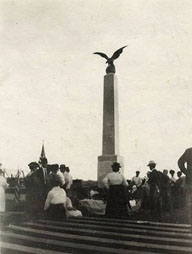 OUR HEARTFELT THANKS TO THE MEN & WOMEN OF THE UNITED STATES ARMED FORCES FOR THEIR TIRELESS SERVICE TO OUR COUNTRY. MANY GAVE THEIR LIVES. The Soldiers & Sailor's
Monument was dedicated on Decoration Day, May 30th, 1921. It
was made possible through the generosity of Oscar E. Bishop,
a Civil War Veteran. In 1917, he offered to match any sum citizens
could raise. The Monument was designed by Miss Maybelle Holland,
a 24-year-old art instructor at the Beatrice Schools. The Wymore
Band performed during the unveiling ceremony and attendees were
given a sprig of greens & flowers to drop at the Monument
while passing. Members & Veterans of the Beatrice Guard,
Grand Army of the Republic, WRC (Women's side of the GAR), American
Legion & Spanish American War were in attendance. |