THE BLUE
SPRINGS CEMETERY
THE EARLY YEARS
Blue Springs, Nebraska
The 1860's were filled with
hope in the Blue River Valley. Robert Wilson arrived in 1857
to build two mills for the Big Blue River Reservation and returned
to Iowa. In 1861, he and his young bride, Amelia, returned to
settle in the little hamlet of Blue Springs near the Reservation's
northern border. There was a trading post, a few log cabins
dug into the banks of Spring Branch, Pawnee and Otoe roaming
the prairie, grass fires, deep winter drifts and several failed
attempts to build a bridge across the Blue River to the east.
It was, it seems, the crystal-clear waters of the river, shelter
from the oak groves and the whispers of the wind in the prairie
grass that persuaded settlers to stay. With hard work and sheer
determination, Blue Springs grew and has endured for nearly 170
years.
Reverend James Johnson arrived in 1855 to minister to the people
of the Reservation and built a log cabin near the river 3 miles
to the north, returning to family in Iowa for the winter. In
the summer of 1857, he brought his family to settle here. A short
time later, their eight-year-old son, Allen, was gathering drift
wood near the river and stepped off a sandbar into deep water
and drowned on September 26, 1857. Reverend Johnson passed away
from typhoid fever, on September 21, 1862. Martha Johnson, a
true pioneer woman, went on to raise her family and passed on
in January of 1899, she was laid to rest beside James and her
son Allen.
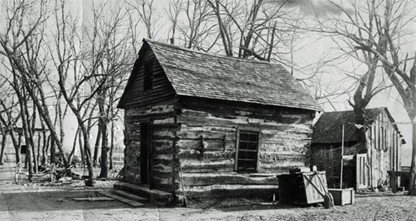
In 1861, James "Grandpa"
Hollingsworth, was superintendent of a very successful Sunday
School in the Johnson cabin. Hollingsworth and his family had
come from England; lived briefly in Boston and Wisconsin; then
decided to make Nebraska their home. They came in a covered wagon,
driving one ox and one horse. It was a hard trip and two of their
children became seriously ill and died on the way. In the meantime,
the Johnsons had built a stick frame home on their farm. The
Hollingsworth's rented the Johnson's cabin for two seasons. In
1857, the cabin was known as the Methodist parsonage and later
in 1861 as the Methodist Sunday School and meeting place. Today
the Johnson Cabin Museum can be seen in the Blue Springs City
Park. (taken from: EARLY METHODISM IN BLUE SPRINGS by Eugene
Watson 1982)
Catharine, James' wife, passed
on in 1886 and James was laid to rest beside her in 1902 in the
Blue Springs Cemetery.
John B. Maxfield, arrived
in 1860 to settle a mile north of Blue Springs. His wife, Orpha
J. (Summers) Maxfield became ill and passed on September 26,
1860. In 1861, he was ordained into the Methodist ministry and
served the Beatrice Circuit for several years.
James Tobyne, the three-year-old
son of James Nelson Tobyne (grandfather of football legend, Guy
Chamberlin) passed away a month later on October 16, 1860. The
Tobyne's operated a freight station on their Homestead a couple
miles NE of Blue Springs in Section 10.
Fifteen-year-old, Lynus Knight,
passed away a few weeks after on November 2, 1860. He was the
son of Lynus & Mary Jane Knight who arrived in the area from
Ohio on June 5 of that year. They farmed, for a time, on the
western edge of Blue Springs south of Bill's Creek. In December
of 1866, Lynus moved to their Homestead with Mary Jane and 4
other children. The Knight Family occupied this land in Section
21 of Sicily Township until 1928.
THE METHODIST CEMETERY
The need for a proper burying ground became clear and tradition
places the founding of the cemetery in 1860 on Robert Wilson's
land. History states that both Allen R. Johnson and Orpha Maxfield
were buried on land occupied by relatives and later reinterred
into the newly established cemetery. It is unclear when these
reinterments were done, but Allen is registered as the first
recorded burial.
Robert Wilson and his wife, Amelia, deeded one square acre in
the NE corner of the NE Quarter of the SW Quarter of Section
8 Township 2 to Trustees of the Methodist Episcopal Church (William
Tyler, James H Johnson and Henry Hollingworth). The deed was
dated January 15, 1862.
The Wilson's lost all three
of their sons very young; Charles (1862-1864), Frank (1866-1867)
and perhaps most tragically, Harry (1872-1894) who died of injuries
during a New Year's football game between Wymore and Blue Springs.
Their daughter, Ella Wilson Swiler lived in Blue Springs until
her death in 1956. Ella served as Secretary on the Blue Springs
Cemetery Board in the 1930s. Today, they all rest in the cemetery
near Robert & Amelia. Their sister Emma Wilson Hoxworth moved
to Illinois when she married and was buried there in 1935.
In 1865, Wilson acquired 1 acre of adjoining land owned by James
Nichols and plotted more lots.
On March 15th, 1868, Nelson Korner purchased 118 acres of land
from Nichols bordering the cemetery on the south and west sides,
leaving the 2nd acre Wilson had plotted as cemetery. On May 28,
1872, Robert Wilson and Nelson Korner deeded the two acres to
the Trustees of the Methodist Church of Blue Springs, expanding
the cemetery to 3 acres. Korner continued to plot his land as
cemetery and in 1885, he deeded 2 acres as Korners Addition.
NELSON KORNER
Nelson Korner was born near Flat Rock, Ohio in 1848. He was a
classmate of George Schock and together they left Ohio in the
Spring of 1868 for Rulo, Nebraska. When a land deal near Rulo
fell through, Nelson decided to pursue Homestead Land farther
west. "To go west was more difficult than it sounded, for
there was no means of transportation. Walking was possible, if
not satisfactory" Mr. Korner stated in his biography. Before
he reached Blue Springs, a friend, who had ridden horseback to
Brownsville to file for a claim overtook him, and the horse carried
the two over many creeks and rivers. 'After fording the Blue
River', Mr. Korner described: we asked a man how far it was to
Blue Springs'. He replied 'Bless you, you are right in it.' The
man was Grandpa Casebeer, grandfather of James Casebeer. The
town was composed of six or seven log houses, and a few others
scattered around the creeks. When he could find no suitable government
land, Mr. Korner bought 118 acres of deeded land [in Section
8 bordering the cemetery] at $2.00 per acre near the townsite.
After buying the land, Mr. Korner spent several days helping
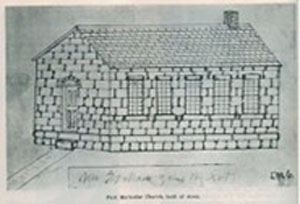
Jacob Casebeer quarry rock, without charge, for the old stone
church." Blue Springs Bee - July 2,1931
A teacher by trade, Korner was hired in 1869 as the first teacher
in Blue Springs.
Old Methodist Stone
Church
once located where the Fire Station
stands today
Korner returned to Rulo for
a time to teach school. When he returned to Blue Springs, a
school district had been organized and a school was to be erected.
In 1869, he was asked to be the teacher. In May of 1870, Nelson
filed for Homestead Land in Section 7 of Sicily Township, after
the government deeded the land to him in 1877, Nelson retained
ownership of the land until his death in 1931. Roland & Ruby
Hardin own this farm today and the original portion of their
home was built by Nelson in 1917. His original farm bordered
the Cemetery. He and his wife are buried in the Korner section
of the cemetery.
CEMETERY RECORDS of the 1870s & 1880s
The newspapers recorded the details of burials.
In June of 1871, Daniel Harpster
had just laid claim to his Homestead when his nine-year-old son,
George, drowned in the Blue River. Funeral services were spoken
and both English and German. The boy had lost his mother, Mary,
that February.
In the fall of 1873, a fire started near the town and damaged
some of the fences in the cemetery.
In July of 1875, a Mr. Ball completed the survey and plat of
the cemetery.
Perhaps the most alarming incident occurred in December of 1876.
Elizabeth Sommers, wife of Levi Sommers, passed on December 15,
1876 and was buried a few days later. The couple had come to
the area only two months before. A few days later in December,
Levi arranged to have her body moved back to their old home near
Springfield, Illinois. Upon opening the grave, it was discovered
her corpse had been stolen. The grave clothes had been cut and
torn from the body and left in the coffin as well as other damage
to the coffin. Grave robbers were prevalent during those years
due to money offered for corpses for medical research. Cold
weather and new burials were favored due to the need for preservation
of the body.
In April, 1887, four-year-old Florence, daughter of Frank McKinney
passed away. Her sister, Edith had died that February.
THE BLUE SPRINGS CEMETERY ASSOCIATION
In April of 1892, a number of the ladies of Blue Springs met
in the Evangelical Church for the purpose of making arrangements
for a supper for the benefit of the cemetery fund and to form
a cemetery association.
On May 16th, 1892 the Blue
Springs Cemetery Association was established. There was a committee
appointed to draft the constitution and by-laws which included
James H. Casebeer, Mrs. A.C. Miover, Miss Anna Craig, E. H. Burington
and W. W. Wright. The by-laws contain 16 articles with are still
in force with very little change. On February 20, 1893 the Trustees
of the Blue Springs Methodist Church deeded the two acres of
the Original section, a plat of lots and $169.57 of funds over
to the Association. On the same date, Nelson & Ella Korner
deeded their 2 acres known as Korner Addition over to the Association.
In March of 1893 the Association was busy preparing to transform
the neglected burying ground filled with weeds and prairie grass
into a "pleasant and attractive house of the dead."
Their description of the scene went on to describe "a tumble-down
fence of rough boards enclosing a patch of prairie, broken by
sunken graves and weed covered hillocks, with half rotten stakes
and struggling rusty tombstones, without a tree or shrub to break
the monotony or soften the glare of summer sun, with no shelter
of protection for visitors or burial parties from storms and
rough winds …"
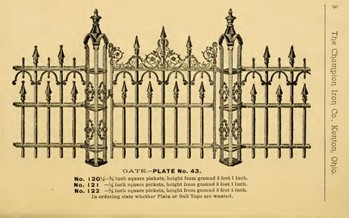
Aside from labor to clean up the grounds, in May 1893 the Association
purchased trees and in August of that year 381 ft of iron fence
arrived from the Champion Iron Co. in Kenton Ohio. The cost
was $306.31 (or 80 cents a foot).
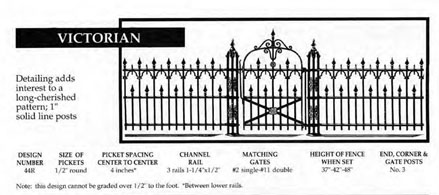
The Champion Iron
Co. - Kenton Ohio
Actual fence from their 1880s catalog
In January 1894, Korner sold
and deeded 2 more acres to the Association which became the First
Addition.
In the summer of 1896, the Association was disgusted by the cemetery
"being made a public pasture and the defacing of monuments
and tombstones by obscene lettering by means of paint as practiced
by conscienceless vandals."
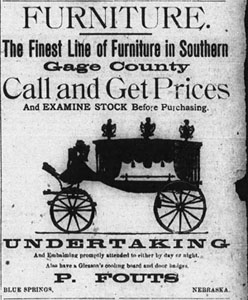
In the fall of 1897, Davis Fouts, a Blue Springs furniture dealer
and undertaker, purchased an "elegant new snow-white hearse"
which was used for funerals.
In June of 1899, a hedge was
removed on the north border and new iron fence installed on the
north side of the cemetery in September.
In May of 1900, Solon M. Hazen, one of the original settlers
and merchants of Blue Springs passed on. He surveyed the town
in 1860 for Robert Wilson and later represented Gage County in
the legislature. Solon's wife, Prissa, passed on a year later
and they rest together in the cemetery.
In 1901 the Association reset
the hitching rail on the east side of the grounds to prepare
for planting a row of shade trees. In 1902, a building was completed
on the grounds which comfortably sheltered and seated 50 people
at a cost of $126.33.
In 1902, an addition to the buildings on the grounds was able
to seat fifty people with protection from sun and rain.
In October 1904, the Association purchased ten rows of Lots
east to west from Korners Addition to become the Second Addition.
In December of 1904, there was a payment of $262.30 which most
likely was new iron fence for the new addition.
In 1905, the Association made
plans to set a row of forest trees along the east side of the
cemetery, allocating one lot in each of the nine blocks to place
25 evergreen trees.
In 1912, the Association prepared to finish the last 300 ft of
iron fence on the southern boundary at a cost of $500.00. The
Champion Iron Works had ceased business about 1909 and Stewart
Iron Works of Cincinnati, Ohio became the new supplier of iron
fence.
The cemetery's Victorian
fence is still being manufactured by Stewart Iron Works.
In 1912, hitching racks were
erected along the south side of the cemetery.
On January 30th, Blue Springs founder, Robert Wilson drank carbolic
acid, mistaking it for castor oil and passed away at the age
of 85. His wife, Ameila Ann, lived on until October 4th, 1927.
The family is buried in the Original section Robert had donated
in 1860.
SOLDIERS &
SAILORS MONUMENT
|
OUR HEARTFELT THANKS TO THE MEN &
WOMEN OF THE UNITED STATES ARMED FORCES FOR THEIR TIRELESS SERVICE
TO OUR COUNTRY. MANY GAVE THEIR LIVES.
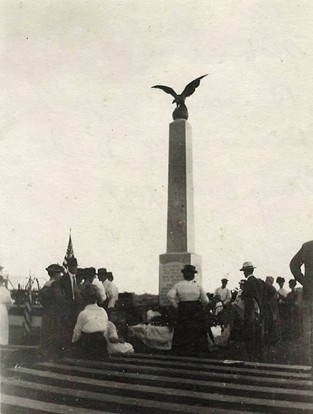
The Soldiers & Sailor's Monument
was dedicated on what was then known as Decoration Day, May 30th,
1921. It was made possible through the generosity of Oscar E.
Bishop, a Civil War Veteran. In 1917, he offered to match any
sum citizens could raise. The Monument was designed by Miss Maybelle
Holland, a 24-year-old art instructor at the Beatrice Schools.
The Wymore Band performed during the unveiling ceremony and attendees
were given a sprig of greens & flowers to drop at the Monument
while passing. Members & Veterans of the Beatrice Guard,
Grand Army of the Republic, WRC (Women's side of the GAR), American
Legion & Spanish American War were in attendance. |
 |
The Fulton Monument Company
was contracted to build and install the monument at a cost of
$1,450 for the monument made from dark barre granite with light
barre base, $153 for drafting and lettering, $550 for the bronze
eagle, $100 for the foundation and $143.71 for shipping and installation,
for a total of $2,690.71.
At the annual meeting of the Association in April 1927, plans
were made to provide water for the cemetery with a 150 gallon
barrel storage cistern which would include a pressure tank and
pump, piped about the grounds with taps at intervals.
1936 - MAJOR IMPROVEMENTS - OLDEST RECORDED CEMETERY
In the spring of 1936, cemetery
visitors noticed many improvements intended to enhance the beauty
and interest in the grounds. Large brick pillars on each side
of the entrances were the work of Jess Kimberly. The pillars
contain a slab of Vermont granite with historic facts about the
cemetery engraved by the Fulton Monument Company. To the right
"Oldest Recorded Cemetery in Nebraska, January 25, 1862
and to the left "Blue Springs Cemetery Founded in 1860".
It was Mr. Fulton who was responsible for confirming evidence
that the cemetery is the oldest recorded in the state, having
made several trips to Lincoln to look up records and other facts
to its connection.
The rest room was beautifully
redecorated, varnished and the floor painted by Charlie Canfield.
It was furnished with new floor coverings, library table, davenport
and chairs.
Cemetery officers and workers
were highly complemented for the nice general appearance of one
of the prettiest little cemeteries in the state.
In 1940, a 24" Whirlwind
Power Mower was purchased to cut the grass.
To be continued ...
1948 - Third Addition
1962 - Dedication for the Memorial to Allen Johnson
2025 - Morris Addition
|